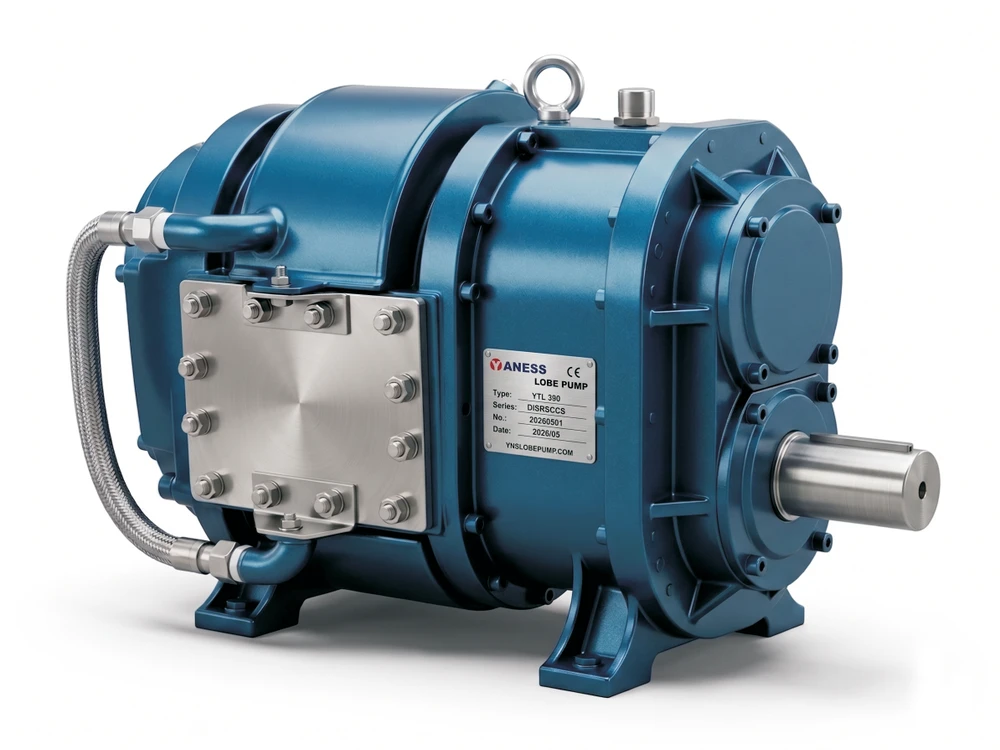
Why Choose a Rotary Lobe Pump for Your Tank Truck?
Quiet operation, renewable wear surfaces, and accessible service parts help keep your tanker working. Match the pump configuration to the cargo and operating conditions.
- Low Noise & Vibration
- Helical tri-lobe rotors. Smoother, low-pulsation flow helps reduce operating noise and vibration.
- Long-Term Service Life
- Replaceable wear surfaces. Wear plates and liners can be renewed to help extend the pump’s usable life.
- Less Maintenance Downtime
- Front-cover access. Supports wet-end maintenance in place where pipework and service clearance allow.
- Self-Priming & Reversible Transfer
- One pump for loading and unloading. Self-priming supports inlet lift; changing drive rotation reverses the flow direction.
- Seal & Gear Protection
- Oil-cooled seal chamber. Supports controlled dry-running during priming and emptying, with a seal-leakage alarm for gear-unit protection. Set speed and exposure time for the duty.
- Cargo & Temperature Options
- Configurable wet end. Select rotor, casing, seals, and solids passage for the cargo. An integrated heating jacket supports temperature management.
Tank Truck Pump Models
Compare flow, pressure, and working speed, alongside the space and drive capacity available on your vehicle.
YL150
- Flow rate
- Up to 60 m³/h
- Max. pressure
- 16 bar
- Working speed
- Up to 530 rpm
YL224
- Flow rate
- Up to 90 m³/h
- Max. pressure
- 16 bar
- Working speed
- Up to 530 rpm
YTL390
- Flow rate
- Up to 138 m³/h
- Max. pressure
- 15 bar
- Working speed
- Up to 600 rpm
Reference limits are not a combined duty point; working speed depends on cargo and suction conditions. Curves and dimensions are available for your installation.
Lobe Pump or Gear Pump for Your Tank Truck?
Already using a gear pump? Compare the same cargo, temperature, flow, and pressure before changing pump types.
When a Gear Pump Fits
For clean oils and other compatible liquids, an existing gear pump may already meet the duty. Compare its actual wear history, particle tolerance, and service requirements.
When to Consider a Lobe Pump
Review a lobe pump if cargo changes, solids, or access for frequent servicing are creating problems. Assess the offered configuration against your current pump’s operating and maintenance needs.
Both types have reversible designs. Loading and unloading alone do not decide the choice.
Lobe Pump vs Gear Pump→ Installation & Operating Notes
Drive & Mounting
Provide PTO speed and torque, hydraulic flow and pressure, or auxiliary-drive data. Include mounting space, permitted package mass, and connection positions. Leave front-cover clearance for service.
Hoses & Pressure Protection
Supply hose bore and length, tank levels, receiving pressure, and the filter, meter, and valve layout. For reversible operation, specify the valve sequence and pressure protection for both directions.
Tank Emptying & Cleaning
Define the residue target, seal support, and shutdown point for final emptying. Plan drainage and cleaning between cargoes, including any hazardous-area, food-contact, or project documentation requirements.